
We often think of change as something grand, massive movements, sweeping reforms, or groundbreaking initiatives. But meaningful transformation doesn’t always require grand schemes. Small acts of positivity can ripple through a community, creating significant and lasting impacts.
That’s the message I heard from someone who is definitely making a big impact in her community, Tanya Stevenson, CEO of the Hervey Bay Neighbourhood Centre.
Tanya talked about the tools and techniques she uses to generate change in the latest Leading & Learning webinar for the Drought Ready Facebook community. (If you’re involved in a Future Drought Fund project, and you want to connect with people across Australia doing very cool things in their communities and industries, you should join!)
You need to watch the whole webinar because Tanya had too many good things to share, but I’ve summarised my main takeaways below.
four pillars
To create lasting change, Tanya talked about the four key principles of PICS:
Pioneer – Don’t go alone. While innovation often requires boldness, working in isolation isn’t the answer. Surround yourself with allies who share your passion.
Innovate – But first, understand. Before diving into solutions, take time to truly understand the challenges. Work with people who will challenge your ideas and offer diverse perspectives.
Champion – Consult your team. Always (always!) seek input from your team before implementing changes. Inclusive decision-making strengthens the movement.
Share – Spread knowledge. Document your “how-to” process, market your efforts, monitor progress, and celebrate successes. Sharing achievements amplifies impact and inspires others.
In the video above, Tanya provides a list of useful tools for every pillar, and there are some that definitely resonated.
Mapping your community
Understanding your community and where you can make a difference is crucial. There are several tools to help you identify intervention points and avoid feeling overwhelmed. One of my favourites is system mapping, which I’ve found invaluable since I first learnt about it.
Think of system mapping as a way to zoom out and see the broader community, recognising existing and potential connections. Then, zoom in on the specific elements you can change right now. By balancing both perspectives, you can make more informed, effective choices.
- Systems thinking resources from Donella Meadows
- Thinking in systems, the book by Donella Meadows (be sure to check out your local library, including via the Libby app, to find a copy)
The Power of 11-13%: the Community Pyramid
Did you know that just 11-13% of a population can create widespread change? I didn’t! Even more interesting, Tanya advised that breaking that 11-13% into even smaller teams of just 5-7 people, each tackling just one objective, is the most effective way to drive transformation.
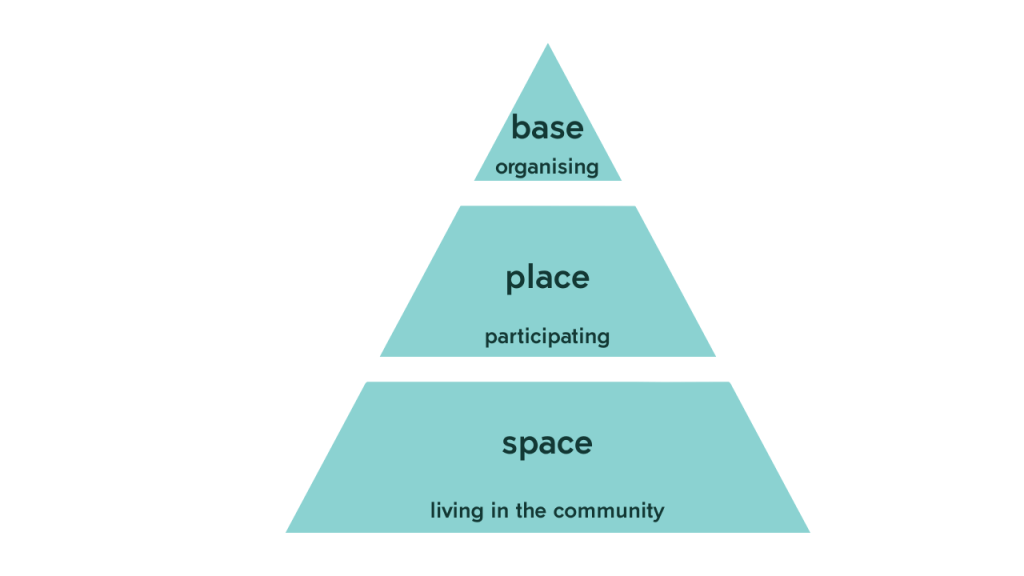
Note: this is my recreation of Tanya’s graphic. Be sure to watch the video to see the original.
Looking at the community pyramid, most people exist in the “space” layer – they live in the community but aren’t actively working on it. A smaller portion are “place” people, who attend events and participate occasionally. The real change-makers form the “base” layer, making up just 11-13% of the community, yet driving all the momentum. But there needs to be people at every level, and they are all an important part of the community ecosystem.
For me, I can think of two examples where I was at very different levels of the pyramid, but I believe both were valuable.
Encouraged action: I was on a small local show community and the poultry pavilion was a little empty, and definitely in need of more visitors. On a trip to the Brisbane Ekka I decided to see what was happening in their poultry areas, to see what could be borrowed and I found Chook Art. The poultry committee in my local town loved the idea and ran with it. It brought in children and their families, it created interest in empty spaces, it generated a buzz for the chooks before the show even opened. In this instance, I was a spark for the base group, and then moved happily down into the “space” level.
Benefited from action: Most Saturdays I get up early and go to my local farmers market. I like knowing I am eating locally and seasonally, supporting smaller/local producers. And I know that if I want the market to remain viable, it needs regular customers and that’s my contribution. In this instance, I am part of the place group.
Borrow, Adapt, Implement
Not every great idea needs to be original. There are incredible ideas, manuals, and strategies already out there – so borrow them! Learning from successful models saves time, energy, and resources. Adapt what works and make it relevant to your community’s needs.
Final thoughts
The beauty of community change is that it’s accessible to everyone. You don’t need a grand vision or unlimited resources – small, intentional actions can have a profound impact. Start by mapping your community, finding your role within the pyramid, and working collaboratively. Innovate thoughtfully, consult your team, and share your successes. And remember, sometimes the best way forward is to borrow, adapt, and build on what already works.
What small act will you take today to make a difference? As Tanya says, we’ve all been someone’s lollipop moment.
Keep reading
The Social Shift Institute has a host of tools and examples, from a workbook on building better communities to report examples.
In this 2022 blog on the ARLF site, Tanya talks about her collaborative leadership style.
Need a primer for strategic planning and visioning? Check out Choosing Our Direction, a booklet on how to make strategic planning successful from Penn State University.
Following on from the Leading & Learning webinar, the Drought Ready Facebook community held a Community Cafe session, where a host of other resources were mentioned, including:
- Platform C – an online knowledge and learning platform powered by Collaboration for Impact in partnership with: Paul Ramsay Foundation; Dusseldorp Forum; Australian Department of Social Services; The Australian Centre for Social Innovation, and Clear Horizon
- Australian Resilience Centre – and you can watch Paul Ryan’s Leading & Learning session from the ARLF as well. Paul is a global leader in resilience, adaptation, and transformation practices. In this webinar, he did a deep dives into why and how change happens and how we can anticipate and respond to it.
- Bank of I.D.E.A.S. – also, you can watch Peter Kenyon OAM‘s Leading & Learning session too. Peter’s presentation centres around breaking free of the preoccupation of the last 50 years with doing things “TO and FOR” community instead of “WITH, OF and BY” community. It is designed to challenge the idea that nothing can happen without a government program or finance from some outside organisation. Instead, Peter champions the belief that “we are the ones we have been waiting for” and that renewal begins with confidence in a grassroots process that is “from the inside out and bottom-up”.
 Lisa Yorkston